In the demanding world of precision engineering, the ground steel plate stands as a critical component for industries where microns matter. Unlike standard rolled steel, a ground plate undergoes a rigorous abrasive process to achieve an ultra-flat surface and a precise thickness, ensuring that mechanical interfaces fit perfectly without the need for extensive secondary machining.
The global demand for high-precision surfaces is driving a shift toward more advanced grinding techniques, moving away from traditional milling to achieve superior surface finishes. Whether it is used as a base for heavy machinery or as a high-tolerance wear plate, the ground steel plate provides the structural stability and flatness required to maintain operational accuracy over long cycles.
Understanding the nuances of surface grinding, material hardness, and parallelism is essential for procurement managers and engineers alike. By selecting the right grade of ground steel plate, companies can significantly reduce assembly time, eliminate vibration in precision equipment, and extend the lifespan of their industrial assets.
Global Industry Context of Ground Steel Plate
The global industrial landscape is currently witnessing a surge in the requirement for extreme precision, particularly within the automotive, aerospace, and semiconductor sectors. According to ISO standards for surface texture, the transition toward automated manufacturing requires a ground steel plate that can guarantee flatness within a few microns across large surface areas.
One of the primary challenges facing modern manufacturers is the inherent instability of raw rolled steel, which often suffers from warping and unevenness. This lack of precision leads to increased failure rates in high-speed machinery, highlighting the necessity of precision-ground surfaces to ensure seamless integration and reduce friction in critical mechanical joints.
Defining the Ground Steel Plate Standards
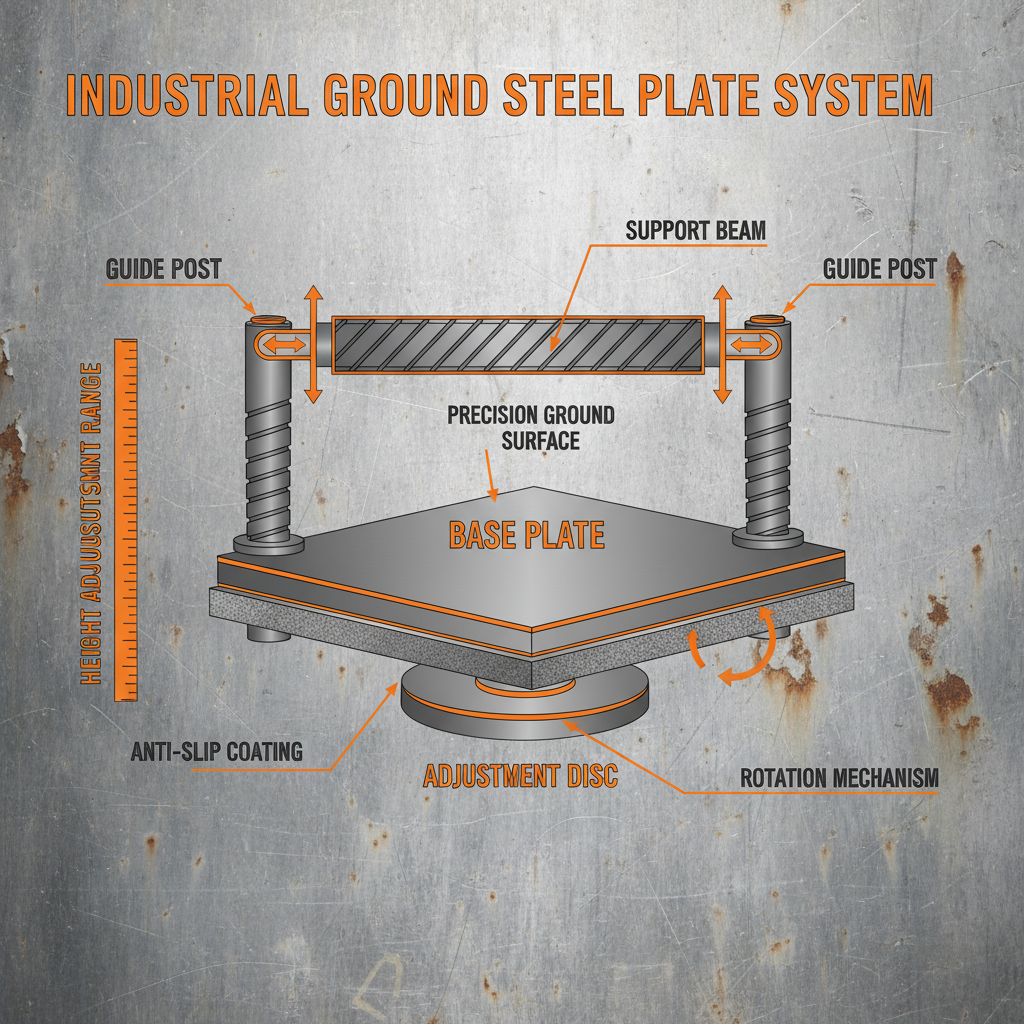
In simple terms, a ground steel plate is a piece of structural or alloy steel that has been processed using an abrasive grinding wheel to remove surface irregularities. Unlike milling or turning, grinding uses a multitude of small abrasive grains to "shave" the metal, resulting in a mirror-like finish and an exceptional degree of flatness that is unattainable through standard rolling processes.
From a technical perspective, this process is deeply connected to the needs of modern infrastructure and humanitarian engineering. In the construction of high-precision bridge bearings or seismic dampers, the flatness of the contact plate determines the distribution of load. A precision-ground surface ensures that stress is distributed evenly, preventing premature fatigue and enhancing the safety of large-scale public structures.
Moreover, the definition of a "ground" plate extends beyond mere aesthetics. It involves strict control over parallelism—the distance between two opposite faces—and perpendicularity. This level of precision is what allows a ground steel plate to serve as the foundation for optical tables, CNC machine beds, and high-pressure vessel seals where even a microscopic gap could lead to catastrophic leaks.
Core Components of High-Precision Grinding
The durability of a ground steel plate starts with the selection of the base material. Whether using high-strength structural steel or specialized tool steel, the material must be stress-relieved through heat treatment before the grinding process begins. This prevents the plate from "springing" or warping after the surface layers are removed, ensuring long-term dimensional stability.
Surface Roughness (Ra) is perhaps the most critical factor. By utilizing fine-grit aluminum oxide or silicon carbide wheels, manufacturers can achieve a ground steel plate surface that minimizes friction and wear. This is particularly vital in applications where the plate acts as a sliding interface, as a smoother surface directly correlates to reduced energy loss and lower maintenance costs.
Finally, the scalability of the grinding process allows for various dimensions, from small precision shims to massive industrial slabs. The integration of CNC surface grinders ensures that the same level of precision is maintained regardless of the plate size, making the ground steel plate a versatile solution for both boutique laboratory equipment and heavy-duty industrial plants.
Performance Metrics and Scalability
When evaluating the quality of a ground steel plate, engineers look at a combination of flatness, parallelism, and hardness. The ability to scale these metrics across large production batches is what separates premium suppliers from standard mills. By optimizing the coolant flow and wheel speed, manufacturers can maintain a consistent finish across thousands of units without compromising the structural integrity of the steel.
The economic scalability also plays a role; by utilizing automated grinding centers, the cost per unit of a ground steel plate has decreased, making high-precision surfaces accessible for mid-sized industrial projects that previously relied on less accurate, cheaper alternatives.
Performance Comparison of Ground Steel Plate Methods
Real-World Applications of Ground Steel Plate
In the heavy machinery sector, the ground steel plate is frequently used as the base for precision guide rails. For example, in large-scale CNC milling centers, the foundation must be perfectly flat to prevent the machine head from deviating by even a fraction of a millimeter, which would otherwise result in scrapped parts and wasted material.
Beyond the factory floor, these plates are essential in specialized infrastructure. In remote industrial zones, such as offshore oil rigs or mining sites, ground steel plate components are used in high-pressure valve manifolds. Their precise finish ensures an airtight seal under extreme pressure, preventing environmental leaks and ensuring the safety of the workforce in hazardous conditions.
Long-Term Value and Economic Impact
Investing in a high-quality ground steel plate provides tangible long-term financial benefits. While the initial procurement cost is higher than that of a standard plate, the reduction in "down-time" is significant. Machines mounted on precision-ground bases experience far less vibration, which extends the life of bearings and motors, effectively lowering the Total Cost of Ownership (TCO).
From a sustainability perspective, the precision of these plates reduces material waste. When components fit perfectly the first time, there is no need for repetitive grinding, shimming, or corrective welding. This lean approach to assembly not only saves time but also reduces the carbon footprint associated with industrial rework and material disposal.
Moreover, the reliability offered by a ground steel plate fosters a culture of trust and safety. In critical applications, such as medical imaging equipment or aerospace testing rigs, the certainty that a component is perfectly flat provides the psychological and technical security needed to push the boundaries of innovation.
Future Innovations in Steel Grinding
The future of the ground steel plate is being shaped by the integration of Industry 4.0. We are seeing the rise of "smart grinding," where sensors embedded in the grinding wheel provide real-time feedback on surface roughness and heat generation. This allows for autonomous adjustments, ensuring that every plate produced meets a "zero-defect" standard.
Furthermore, the shift toward green energy is introducing new materials into the grinding pipeline. The use of recycled high-strength steels, combined with cryogenic grinding—which uses liquid nitrogen instead of traditional oils—is making the production of the ground steel plate more eco-friendly and sustainable for the next generation.
Digital twinning is also playing a role, allowing engineers to simulate the grinding process virtually before a single piece of metal is touched. This minimizes trial-and-error and allows for the optimization of the ground steel plate geometry for specific, high-stress applications, further pushing the limits of mechanical precision.
Comparative Analysis of Ground Steel Plate Specifications
|
Material Grade
|
Flatness Tolerance
|
Surface Finish (Ra)
|
Typical Application
|
|
Standard Carbon Steel
|
± 0.05 mm
|
0.8 - 1.6 μm
|
General Industrial Bases
|
|
Alloy Tool Steel
|
± 0.01 mm
|
0.4 - 0.8 μm
|
Precision Die Sets
|
|
Hardened Steel
|
± 0.005 mm
|
0.2 - 0.4 μm
|
Calibration Plates
|
|
Stainless Steel 316
|
± 0.03 mm
|
0.6 - 1.2 μm
|
Food Grade Platforms
|
|
High-Strength Low Alloy
|
± 0.02 mm
|
0.5 - 1.0 μm
|
Bridge Bearing Plates
|
|
Specialized Vacuum Steel
|
± 0.002 mm
|
0.1 - 0.2 μm
|
Semiconductor Stages
|
FAQS
The primary difference lies in the surface precision and flatness. A rolled plate is a raw product with inherent variations in thickness and a rougher surface. A ground steel plate has been processed with abrasive wheels to remove these variations, achieving a precise thickness and a high-degree of flatness, which is essential for high-precision mechanical assembly and reducing vibration.
The Ra (average roughness) should be determined by the intended application. For general industrial supports, a value between 0.8 and 1.6 μm is usually sufficient. However, for sliding interfaces or precision seals, you should specify a finer finish, typically between 0.2 and 0.4 μm, to minimize friction and prevent leakage.
While high-quality ground plates are stress-relieved to prevent this, extreme temperature fluctuations or improper mounting (over-tightening bolts) can cause deformation. To minimize this risk, we recommend using materials that have undergone professional annealing and ensuring that the plate is supported uniformly across its entire surface area.
Grinding is generally more expensive per hour of machine time, but it is often more cost-effective for achieving ultra-high precision. Milling can leave "tool marks" and may struggle to achieve the same mirror-like flatness as grinding. For tolerances below 0.01mm, grinding is the industry standard and the most reliable method.
The most common materials include cold-rolled carbon steel for general use, alloy tool steels for high-wear environments, and stainless steel for corrosive or hygienic applications. The choice depends on the required hardness, corrosion resistance, and the specific load the plate will bear in its final application.
Flatness is typically verified using a CMM (Coordinate Measuring Machine), a precision dial indicator on a granite surface plate, or optical interferometry for ultra-high precision. These methods ensure that the plate meets the specified tolerance across its entire surface, providing a certified quality report for the end user.
Conclusion
The ground steel plate is more than just a piece of metal; it is the foundation of precision in modern manufacturing. From ensuring the stability of CNC machinery to providing airtight seals in high-pressure environments, the technical advantages of grinding—flatness, parallelism, and superior surface finish—translate directly into operational efficiency, increased safety, and reduced long-term maintenance costs.
As we move toward an era of smart factories and sustainable infrastructure, the demand for high-precision materials will only grow. Investing in premium, precision-ground surfaces today is a strategic decision that ensures your equipment remains competitive, reliable, and ready for the technological demands of tomorrow. For high-quality solutions, visit our website: www.baidysteel.com